News / Industrial · Product
Industrial shutters: seven parts, and the three that decide the job
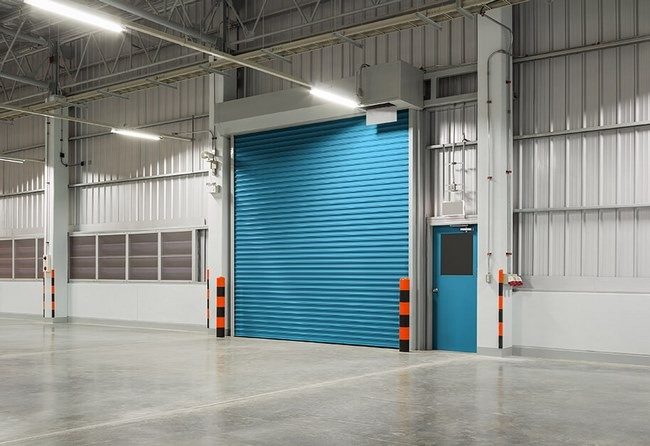
A warehouse shutter is seven assemblies. Three of them — the slat, the balance spring and the operator — decide whether the door survives its duty cycle; the other four are fitting work.
An industrial shutter closes an opening a warehouse or a factory has to use all day, which makes duty cycle the specification that matters rather than the size of the hole.
It is seven assemblies: the slat curtain, the bottom rail, aluminium guides with their brackets, the barrel, the balance springs, the operator with its control box and clutch, and a mechanical cross lock for when there is no power. Four of those are fitting work. Three decide the job.
The slat sets the span. Wide-span sections in 6063-T5 and T6 run from 1.4 mm up to 2.5 mm, closing openings from 8.5 m to 10.5 m wide, and the ends are capped in three layers because the end cap is the joint that takes the wear on a curtain this size.
The balance springs carry the curtain, not the motor. Wound correctly, the motor only starts and stops it; wound to the wrong mass, the motor carries the difference on every cycle. And the operator is sized against the weighed curtain — past about 40 m² that means a three-phase unit, because a single-phase motor on an industrial duty cycle runs hot long before it runs out of torque.
Aluminium is one of three curtain materials in normal use; the others are PVC, where a door has to be fast and light, and stainless link, where it has to be seen through. Aluminium is the one that takes a coating, which is what decides how the door looks in year ten.


